
16th May 2010
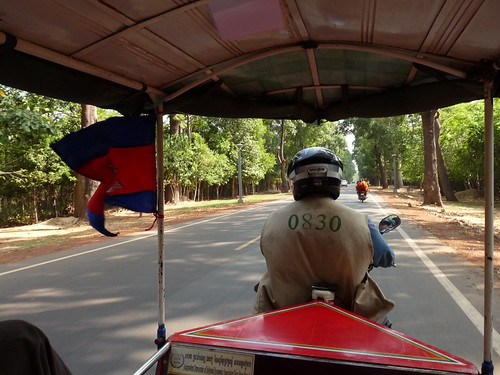
We had arranged with our new tuk-tuk driver to set off around 9am this morning and head out to explore some of the ancient temples of Angkor.
Angkor is a region of Cambodia that served as the seat of the Khmer empire, which flourished from approximately the ninth century to the thirteenth century. The ruins of Angkor are located amid forests and farmland to the north of the Great Lake (Tonle Sap) and south of the Kulen Hills, near modern-day Siem Reap, and are a UNESCO World Heritage Site. The temples of the Angkor area number over one thousand, ranging in scale from nondescript piles of brick rubble scattered through rice fields to the magnificent Angkor Wat, said to be the world’s largest single religious monument.
We had decided not to visit Angkor Wat today, but to leave that for another day when we would come out early and watch sunrise here. Instead, after purchasing our tickets we headed for Angkor Thom. This was the last and most enduring capital city of the Khmer empire covering an area of 10km². A fortified city containing several monuments from varying eras. The ancient city is believed to have supported a population of 1 million at a time when London’s was only 50,000.
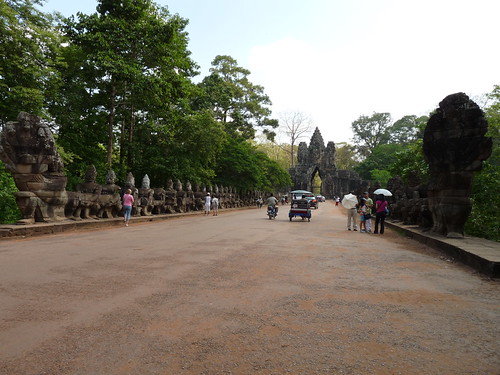
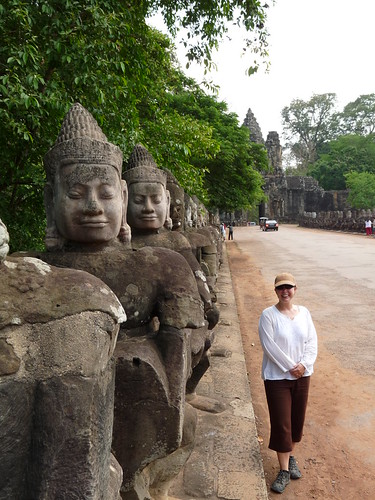
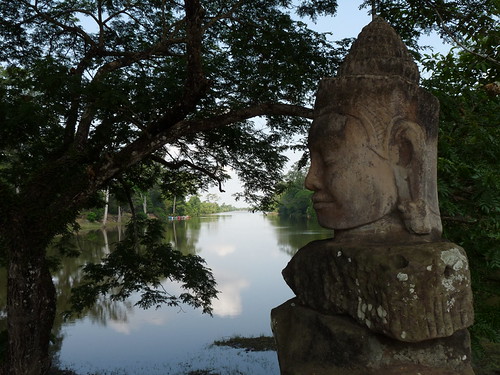
At the centre of the city stands the King’s state temple, the Bayon. This is where we began our visit. This is a place of stooped corridors, precipitous stairways and a unique collection of 54 gothic towers each decorated with 4 enigmatic faces staring down, totalling 216 huge heads exuding power and control with a hint of humanity. From a distance, the temple looked much like a collection of old stones, but as we explored we realised it was actually quite a magical place.
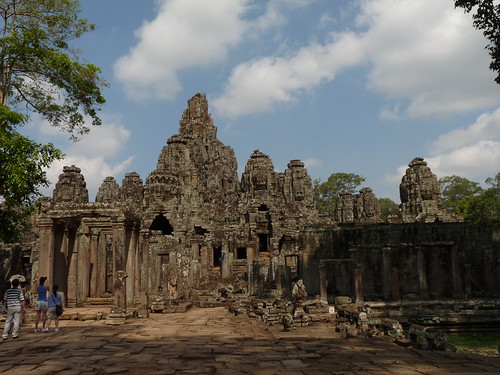
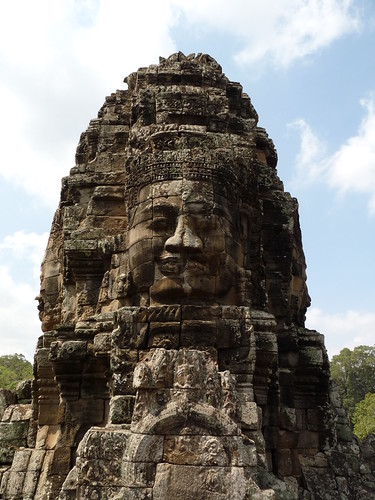
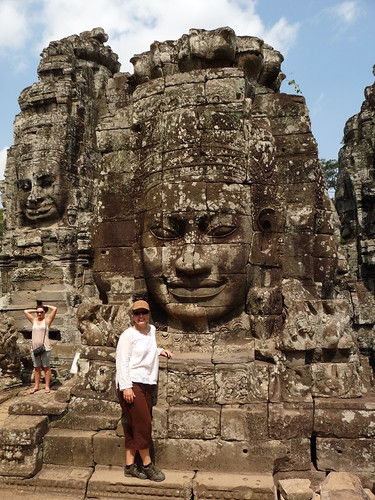
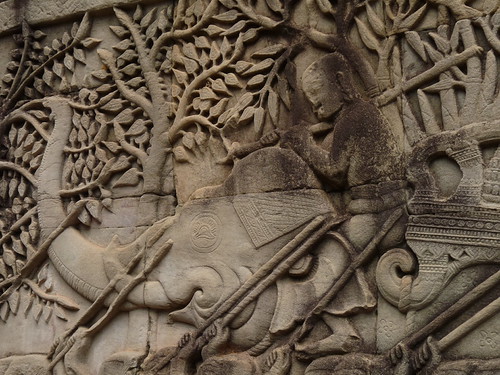
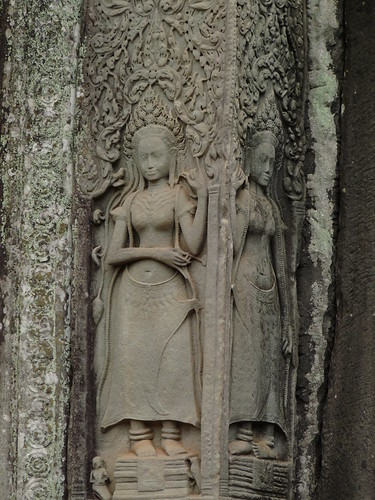
Set over three levels, as we climbed up to the third level, a multitude of heads were visible at any one time, some looking down, some at eye level, face on or in profile. The some 1.2 km of bas relief carvings incorporating over 11,000 figures were extraordinary. The detail in scenes depicting daily life in 12th century was amazing considering their age.
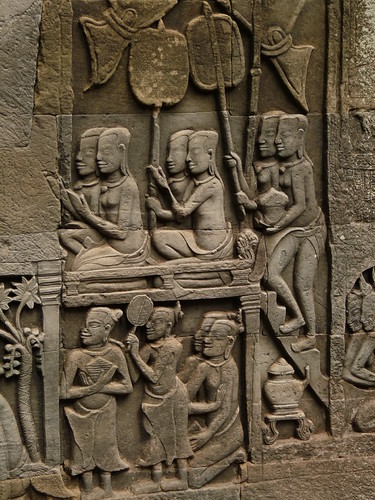
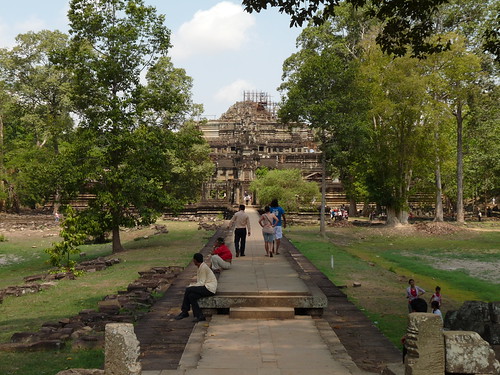
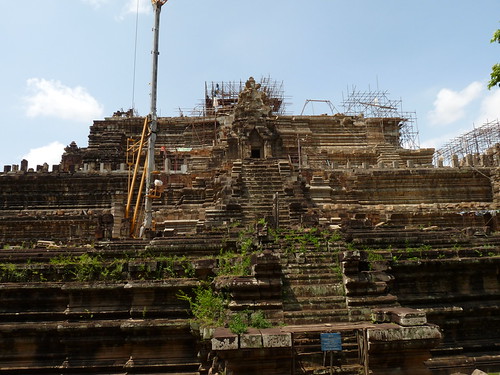
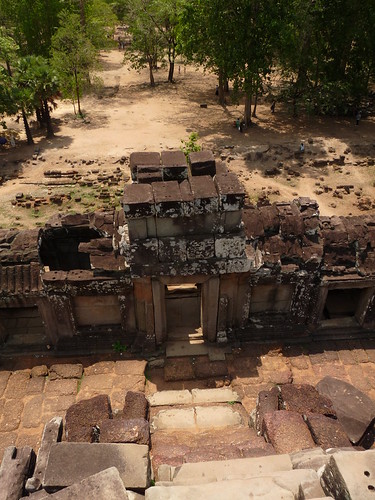
After the temple at Bayon, we headed over to the Baphuon. This was the centre of a restoration project when the Cambodian civil war erupted and work was halted for a quarter of a century. Unfortunately, the temple had been take apart piece by piece as part of the renovation, but during the war all the meticulously written records were destroyed. This has left experts with the world’s largest jigsaw puzzle. The restoration work is still ongoing and a plethora of stones litter the area surrounding the half-finished building. Baphuon is approached by a 200m long raised walkway.
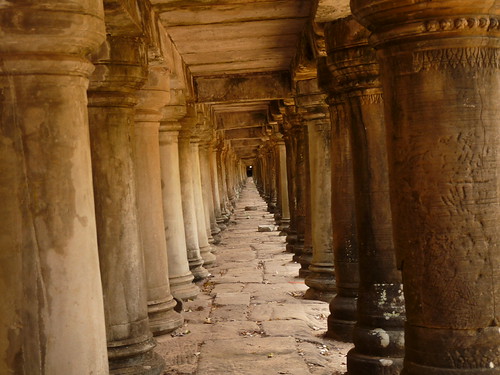
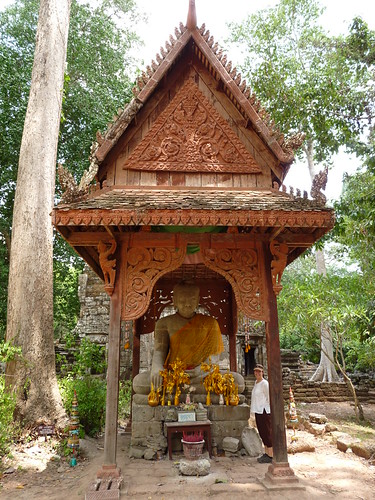
By now the sun was high in the sky and we wandered around the back of the Baphuon, which was mercifully a bit shaded and quieter in terms of people. Our destination was Preah Palilay, billed as one of the most atmospheric temples in Angkor Thom. It originally housed a Buddha which has long since vanished, but been replaced by another (there are Buddhas placed througout the entire site wearing an orange sash). There are several enormous trees looming large over the central sanctuary which is blissfully peaceful, set as it is away from most of the other main buildings.
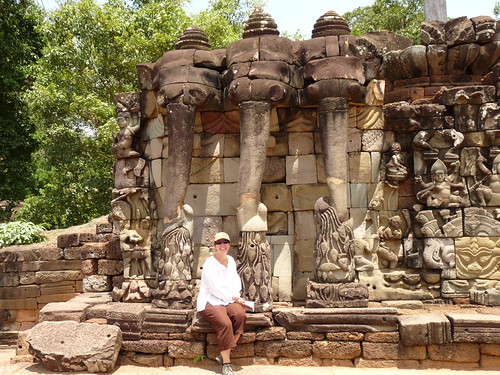
We passed through the Terrace of the Leper King with its stunning carvings and onto the Terrace of the Elephants. This 350m long terrace was used as a viewing platform for ceremonies. It would have been an amazing place to stand and watch the pomp and splendour of ancient ceremonies.
We thankfully climbed back into our naturally ‘air-conditioned’ tuk-tuk and continued our explorations of the many temples at Angkor with Ta Prohm, perhaps better known as the temple that starred in Tomb Raider.
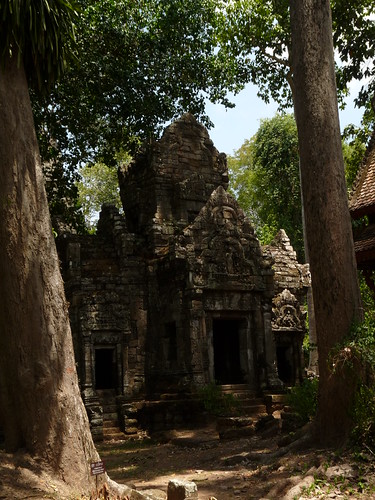
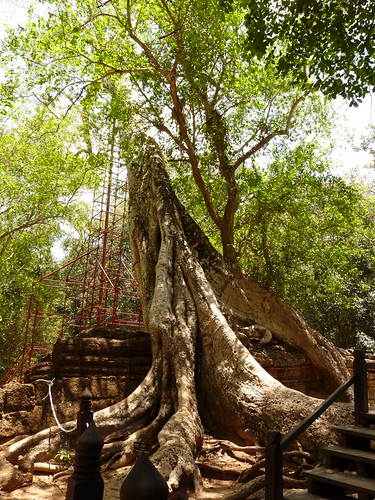
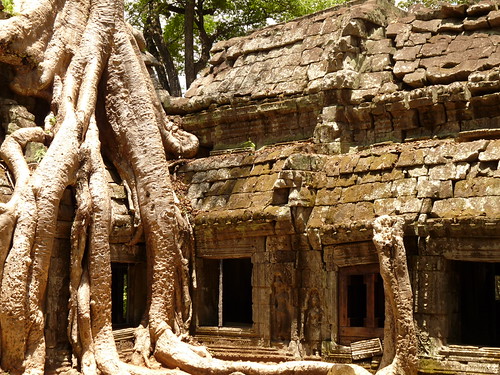
This is another of the popular temples on the tourist trail at Angkor and we were hopeful that since it was now lunchtime it would be a quieter time to visit. As we entered by the west gate, there was a coach party leaving, but the main temple itself which is fairly small was still quite busy.
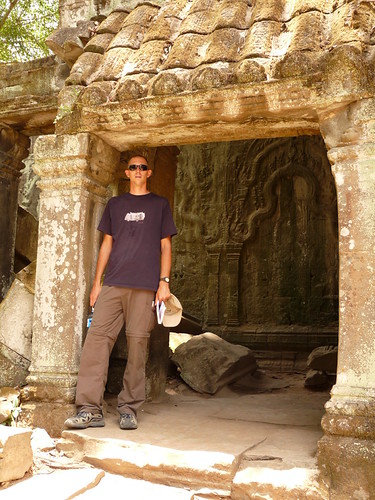
Unlike the other temples at Angkor, this one is fighting the encroaching jungle, although much less wild than we had expected. It is very much a manicured overgrowing by the jungle with us searching for areas of the temple overgrown by giant tree roots, rather than these sights being visible at every turn.
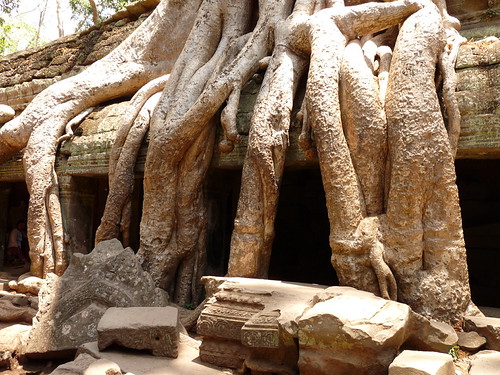
It is still a magical experience however, with dappled shade cast over crumbling towers and walls being slowly embraced by giant roots. Ta Prohm is a temple of towers, closed courtyards, and narrow passageways, many of the latter impassible due to rock falls, clogged with jumbled piles of delicately carved stone blocks dislodged by the roots of long decayed trees.
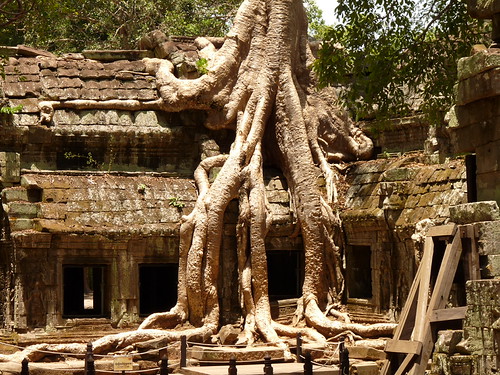
After our exploration of the other-wordly Ta Prohm we decided the heat was too much and headed back to Siem Reap for a late lunch and a wonderfully air-conditioned room.